
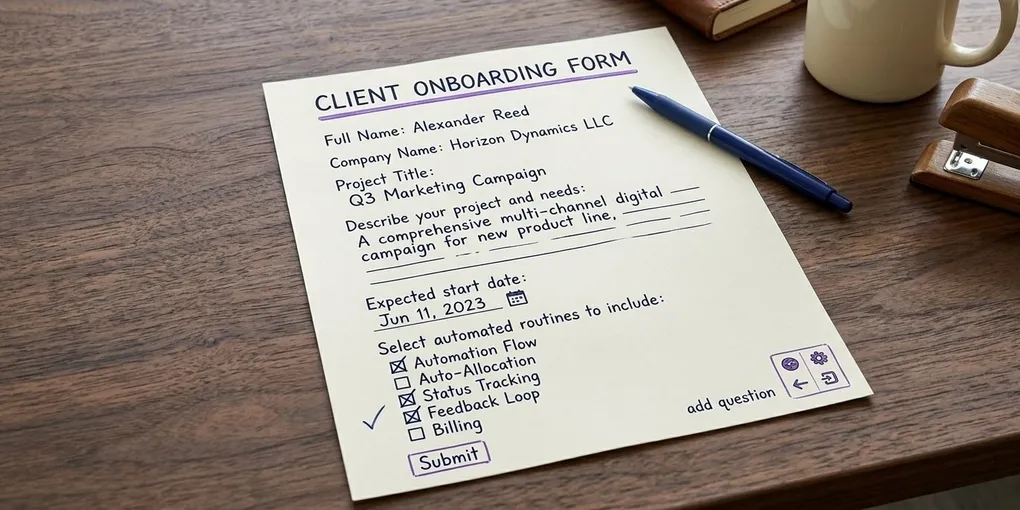
How to automate client intake, payments, and booking in one flow
For many service-based freelancers, the booking process is not actually one process.
A client finds you, fills out a form somewhere, waits for a reply, gets a payment link in a separate email, and then receives a booking link to finally choose a time. What should feel smooth and professional often becomes a disconnected chain of steps held together by manual admin. It works at first. Until it doesn’t.
As your business grows, that fragmented setup starts creating friction everywhere. Leads drop off between steps. You spend too much time chasing replies, confirming details, and sending payment links manually. Clients get confused about what happens next. And the booking experience starts feeling more complicated than the service itself. That is why more freelancers are looking for ways to automate client intake, payments, and booking in one flow.
Not because they want more software, but because they want fewer gaps in the client journey. In this guide, we’ll look at why disconnected systems create problems, what a unified booking flow should include, and how to automate intake, payment, and booking in a way that feels easier for both you and your clients.
Why disconnected booking workflows create so much friction
A lot of freelancers build their process in layers. They start with a calendar tool. Then add a form. Then connect a payment processor. Then create email templates to explain the next step. Then manually review submissions and decide who gets a booking link. None of these tools are necessarily bad. The problem is that they are often not designed to work as one seamless experience.
When intake, payment, and booking all happen separately, you create more opportunities for drop-off, confusion, and admin. A lead may complete the first step and never return for the next one. Someone may book without sharing the information you actually need. Another client may receive a payment link but delay choosing a time. You end up spending time managing the gaps instead of delivering the service.
This is especially common in service businesses where different offers require different levels of commitment. A quick discovery call may need no payment. A paid strategy session may require upfront payment. A custom project may need detailed intake and manual approval before booking can happen at all. Once your offers stop following the same path, disconnected tools become even harder to manage.
What it means to automate intake, payments, and booking in one flow
Automating client intake, payment, and booking in one flow means building a process where each step naturally leads into the next, without manual intervention and without sending the client through a messy sequence of unrelated links. Instead of asking clients to fill out a form, wait for an email, make a payment elsewhere, and then book at the end, the process is handled inside one connected experience.
That might look like this:
Discovery Call
Choose service → Pick a time → Instant booking confirmation
Paid Consultation
Choose service → Complete intake questions → Pay upfront → Pick a time → Booking confirmed
Custom Service Inquiry
Choose service → Fill out detailed form → Submit request → Review and approval → Payment and booking step
The exact flow depends on the service. That is the point.
The most effective automation does not force every offer into the same booking path. It adapts the process based on what the client is actually trying to book.
Why a unified flow improves conversion and saves time
A connected workflow does more than make your admin cleaner. It usually improves the client experience too.
When people know what to do next, they are more likely to complete the process. When payment is built into the flow, commitment tends to be stronger. When intake happens before the booking is confirmed, you get better information earlier and avoid unnecessary back-and-forth. This creates several practical benefits.
First, you reduce drop-off between steps. The fewer separate actions a client has to remember or come back to later, the more likely they are to complete the process. Second, you reduce manual admin. You stop sending the same explanations, chasing missing information, and pasting payment links into emails. Third, you improve lead quality. If the right questions are asked before a booking is confirmed, you spend less time on calls with people who were never a fit. And fourth, the whole business feels more professional. A smooth booking journey signals that your service is organised, considered, and easy to work with.
What a strong automated booking flow should include
The best systems do not just stack features together. They connect them in a logical order.
A strong flow usually includes service selection, intake questions, payment logic, and booking confirmation. In some cases, it also includes an approval step before the client can proceed to payment or scheduling. Just as importantly, the process should be flexible by service.
That means your low-friction offer can stay simple, while your higher-ticket or more customised service can include extra steps without making the entire system feel heavy.
For example, you might want:
- Instant booking for discovery calls
- Upfront payment for paid sessions
- Deposit collection for in-person services
- Request-to-book for custom projects
- Different intake forms depending on the service
This is where many basic scheduling tools fall short. They may include forms or payment options, but they often do not let you combine those features differently for different services.
How Foundslot helps automate the whole flow
Foundslot is especially useful for service-based freelancers because it is built around service-specific workflows rather than one generic booking path. That matters when your offers do not all work the same way.
Instead of using one tool for intake, another for payments, and a third for scheduling, Foundslot allows those steps to work together inside one system. More importantly, it lets you shape the flow differently depending on the service. That means you can keep one offer simple and instant, while making another more structured and qualification-based.
Here is what that can look like in practice:
Discovery Call
Choose service → Pick time → Instant confirmation → Reminder sent
Paid Strategy Session
Choose service → Answer intake questions → Pay upfront → Choose time → Booking confirmed
Custom Project
Choose service → Complete detailed intake form → Submit request → Review manually → Approve → Payment and booking step
Local In-Person Service
Choose service → Enter location → Confirm service area → Choose time → Pay deposit → Booking confirmed
This is a very different experience from stitching together separate tools and trying to manually manage what happens between them.
Signs your current process needs automation
A lot of freelancers keep using a fragmented setup because it still works “well enough.” But usually the warning signs are already there. Your process probably needs to be more automated if you often:
- Send forms and booking links separately
- Manually collect missing information after someone books
- Chase people for payment before confirming a time
- Review whether a lead is a fit only after a call is already booked
- Explain the next step over email again and again
- Lose leads somewhere between inquiry and confirmed booking
These are all signs that your process has too many gaps. And those gaps cost more than time. They also affect conversion, clarity, and client trust.
How to build a better flow
The easiest way to improve your setup is to stop thinking about forms, payments, and booking as separate pieces. Think instead about the ideal path for each service.
Ask yourself:
What does the client need to do first?
What do I need to know before accepting this booking?
Should payment happen before or after approval?
Can this service be booked instantly, or should it start as a request?
Once those answers are clear, the right flow becomes much easier to design. That is also why one-size-fits-all scheduling tools often stop working as a business grows. The issue is not just that you need more features. It is that different services need different booking journeys.
Final thoughts
If your current booking process depends on multiple links, manual emails, separate payment requests, and repeated follow-up, it is probably costing you more time and more leads than you realise. Automating client intake, payments, and booking in one flow is not about making your business feel robotic. It is about removing unnecessary friction so the right clients can move forward more easily. The best booking systems do not just let people choose a time. They help you collect the right information, secure commitment, and guide each service through the right workflow.
That is where Foundslot stands out. It gives service-based freelancers a way to combine intake, payments, and booking into one smoother flow, while still adapting the process based on the service being booked.