

Best Booking Software for Freelancers With Different Scheduling Needs
For many freelancers, booking software seems like a simple choice at first. You pick a tool, connect your calendar, send a link, and let clients choose a time.
That works well until your business stops being simple.
The moment you offer multiple services, need different rules for different offers, collect intake information before accepting a booking, charge deposits, or manually approve certain requests, a basic scheduler can start creating more work than it saves. Instead of streamlining your admin, it forces you to patch together forms, payment links, emails, and manual follow-up.
That is why freelancers with more advanced operations need to think differently about scheduling tools. The best platform is not just the one that lets people pick a time. It is the one that supports the way your business actually runs.
In this guide, we’ll compare the best booking software for freelancers with complex scheduling needs, what features matter most, and which kind of tool makes sense depending on your workflow.
What counts as “complex scheduling needs”?
Complex scheduling does not mean your business is messy. It usually means your services are more nuanced than a standard calendar link was designed for.
Maybe you offer several services, and each one needs a different process. Maybe discovery calls can be auto-booked, but premium work requires review first. Maybe you need clients to answer specific questions before you even decide whether to accept the booking. Maybe your service depends on location, travel distance, timing rules, or payment conditions.
These are all normal needs for established service-based freelancers. The problem is that many booking tools are built for a much simpler use case: one person, one meeting type, one calendar, one booking flow.
If that is no longer your reality, you need software that can handle more than time slots.
What freelancers should look for in booking software
The best booking software for a complex freelance business should do more than display availability. It should help you qualify leads, reduce admin, and protect your time.
A strong system usually includes flexible service-specific workflows, intake forms, payment collection, calendar syncing, reminders, and at least some ability to control how bookings are accepted. For many freelancers, it is also important to choose between instant booking and request-based booking depending on the service.
This is especially true for consultants, photographers, coaches, designers, trainers, beauty professionals, event providers, and other freelancers whose services are not completely standardized.
In other words, the ideal tool does not force every offer into the same process. It adapts to the way each service needs to be sold and delivered.
Best booking software for freelancers with complex scheduling needs
There is no single best tool for every freelancer. The right choice depends on how much complexity your business actually has.
Some freelancers mainly need a polished scheduling link with reminders. Others need approval workflows, qualification forms, travel restrictions, and payment rules built into the booking process itself.
Here is how the main options compare:
| Tool | Best for | Strengths | Limitations | Best fit level |
|---|---|---|---|---|
| Foundslot | Freelancers with custom service rules and layered workflows | Flexible booking flows, request or auto-book options, intake questions, payment logic, service-specific rules | More than needed for very simple scheduling | High/Medium-complexity service businesses |
| Calendly | Straightforward calls and appointments | Easy setup, clean interface, reliable calendar syncing, familiar user experience | Limited flexibility for advanced qualification or service logic | Low-complexity scheduling |
| Acuity Scheduling | Appointment-based businesses that want payments included | Payments, packages, intake forms, solid for structured appointments | Can feel restrictive for more conditional or approval-heavy workflows | Medium-complexity service businesses |
| Dubsado | Freelancers who want CRM + forms + contracts + workflows | Strong back-office workflows, proposals, contracts, client management | Heavier setup, scheduling is not always the main strength | Medium to high complexity, broader operations |
| SimplyBook.me | Traditional appointment-style businesses | Feature-rich appointment system, service menus, client booking options | Better for standard appointment models than customized freelancer logic | Medium complexity, standard service menus |
1. Foundslot
Foundslot is best suited to freelancers whose booking process already includes more than a simple calendar handoff. If your services have different rules, if some clients should request to book while others can book instantly, or if your workflow depends on qualification, payment, or service-specific logic, this is the kind of tool that makes more sense than a generic scheduler.
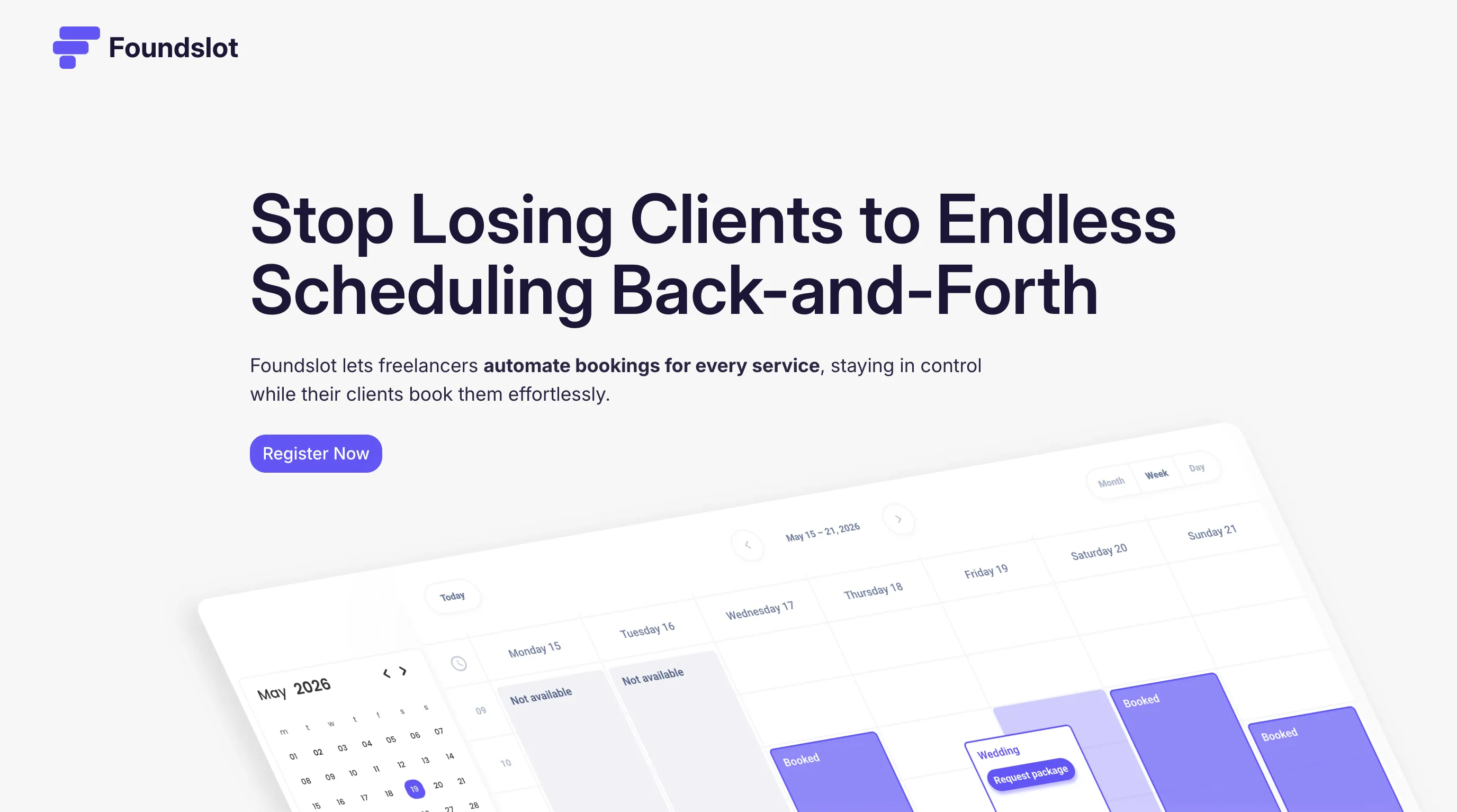
What makes it stand out is that it is designed around operational flexibility. Instead of expecting every service to follow the same path, it allows different booking experiences depending on what you offer. That matters a lot once your business grows beyond one-size-fits-all appointments.
Foundslot is particularly strong for service-based freelancers who are starting to feel the weight of admin. If you are manually reviewing requests, sending separate payment links, or relying on a mix of forms and calendar tools to make one booking happen, it addresses that pain directly.
Its main tradeoff is simple: freelancers with very basic needs may not need this level of flexibility yet. But for businesses with real scheduling complexity, that flexibility is exactly the point.
2. Calendly
Calendly remains one of the most popular scheduling tools because it does one thing very well: it makes booking simple. For freelancers offering discovery calls, consultations, or straightforward appointments, it is fast to set up and easy for clients to use.
Its strength is clarity. You send a link, the client picks a time, reminders go out, and your calendar stays synced. For many solo professionals, that covers the essentials.
Where it starts to struggle is when your services require more nuance. If bookings need approval, if your intake process is important, or if different services need different rules, Calendly can begin to feel like a good tool being pushed beyond its natural use case.
It is still an excellent option for simple scheduling. It is just not always the best long-term fit for freelancers whose operations are more customized.
3. Acuity Scheduling
Acuity is often a strong middle ground. It works well for freelancers who want a more appointment-centred system with payments and forms built in. It is especially useful for businesses where clients are expected to self-book and where the service structure is fairly clear.
For wellness professionals, beauty services, coaches, and other appointment-led businesses, Acuity can cover a lot without needing additional tools. It handles payments, service options, and intake forms better than many lightweight schedulers.
That said, the more complex and conditional your process becomes, the more likely you are to hit friction. Acuity is strongest when your business follows structured appointment logic, not when every service has a different qualification path.
4. Dubsado
Dubsado is a broader client management platform rather than a pure scheduling tool, and that is both its strength and its limitation.
For freelancers who want forms, contracts, invoices, proposals, workflows, and client management in one place, it can be extremely useful. Designers, creatives, consultants, and service providers with longer client journeys often like it because it handles more of the business relationship, not just the appointment.
But that also means it can feel heavier than necessary if your main issue is booking flow. If what you really need is smarter scheduling rather than a full business operations system, Dubsado may solve more than the problem you came in with.
It makes the most sense when scheduling is just one part of a larger, more involved client process.
5. SimplyBook.me
SimplyBook.me and similar tools are often a good fit for businesses with more traditional appointment models. If you run a service menu, want clients to browse and book from clear options, and need a fairly feature-rich appointment platform, it can do the job well.
It is generally better suited to standard booking setups than to highly customized freelancer workflows. That does not make it weak, just different in focus. If your complexity comes from volume and service variety within a standard appointment structure, it can be a strong option. If your complexity comes from qualification, approvals, layered service rules, or unusual workflows, other tools may fit better.
Which tool is right for you?
The easiest way to choose is to ask yourself where the complexity in your business actually comes from.
If your clients can book instantly, your services follow roughly the same process, and you do not need much pre-booking information, a simple scheduler like Calendly may be enough.
If your work is more appointment-based and you want payments and intake forms included, Acuity may be the better middle-ground choice.
If your booking process is part of a broader admin and client-management system, Dubsado may make sense.
But if your business depends on custom service flows, approvals, conditional questions, travel or area rules, or different logic depending on the service, then you are no longer really looking for a basic scheduler. You are looking for a booking system that can mirror how your business actually operates. That is where a tool like Foundslot becomes a much stronger fit.
Signs you’ve outgrown your current booking tool
A lot of freelancers do not notice the problem right away because the pain shows up in small ways. You may find yourself spending too much time replying to leads before they can book, fixing wrong bookings, sending separate payment requests, or reviewing requests that should have been filtered earlier.
Another common sign is that you start avoiding promoting certain services because booking them is too annoying to manage. That is usually a clue that the system is no longer supporting growth.
When your booking process regularly creates manual work, confusion, or lost time, it is worth treating it as an operational issue rather than a minor inconvenience. In many cases, better booking software does not just make things easier. It improves lead quality, reduces no-shows, and frees up time you can actually use to serve clients or grow the business.
A softer, clearer next step
If your current setup still works, there is no need to replace it just for the sake of replacing it.
But if you are already stitching together forms, payment links, DMs, emails, and manual approval just to manage bookings, it may be time to look at a system built for a more complex workflow.
Foundslot is worth exploring if you want a booking process that feels easier for clients and lighter for you.